

Learn
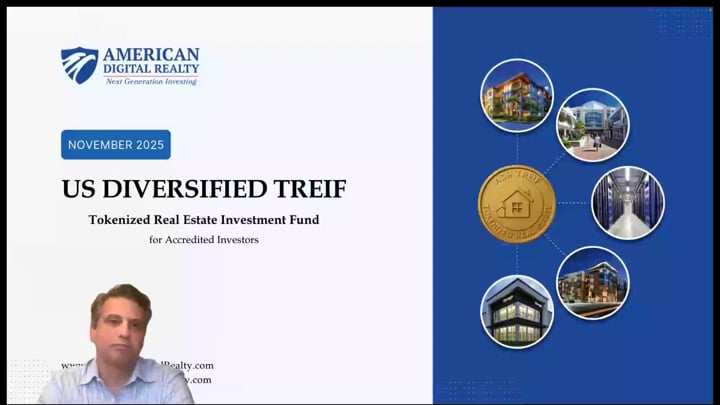
1 - Introduction to ADR and TREIFs
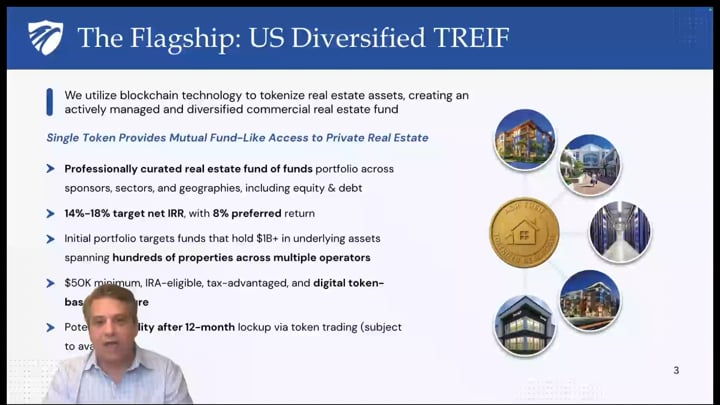
2 - US Diversified TREIF
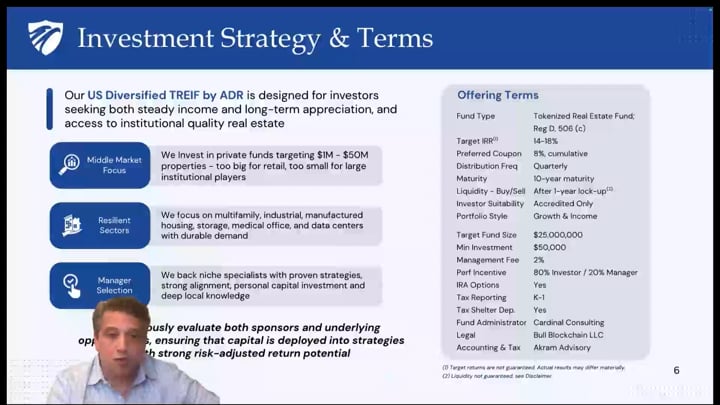
3 - Optimizing the Efficient Frontier with Private Commercial Real Estate
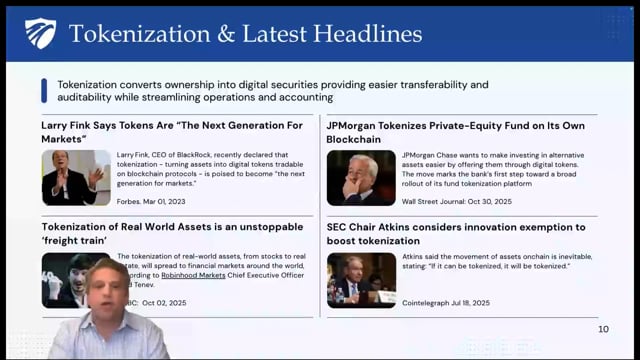
4 - Benefits and Adoption of Tokenization
5 - Underlying Investments
6 - Our Team and How to Invest
American Digital Realty was created to give investors a simpler way to get diversified exposure to private, middle-market commercial real estate.
TREIFs are tokenized real estate investment funds, designed like mutual funds/ETFs conceptually, but applied to private real estate.
The flagship US Diversified TREIF is positioned as a US-focused vehicle across multiple property sectors and strategies.
Tokenization is the recording ownership as digital tokens, adding flexibility and features while keeping real estate fundamentals intact.
The flagship fund is a fund-of-funds structure that allocates to established managers rather than operating properties directly.
The goal is to curate and aggregate exposure so investors can access institutional-quality deals without sourcing, underwriting, and managing multiple relationships themselves.
Targets and terms:*
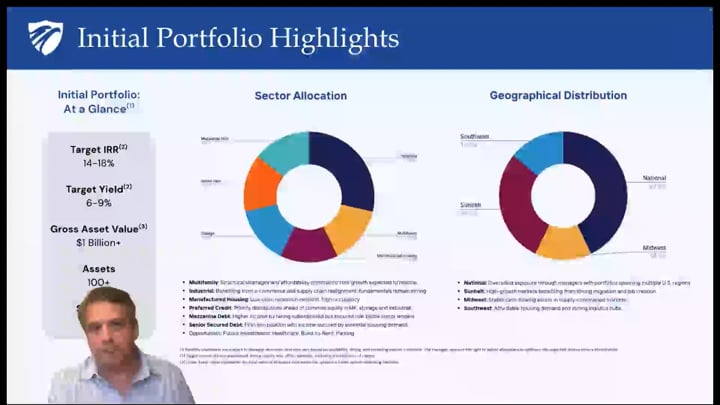
14-18% net IRR target
8% preferred return (paid quarterly)
$50,000 minimum
IRA eligible
1-year lockup, then potential secondary liquidity
We look at diversification within the context of Modern Portfolio Theory and the efficient frontier: maximizing expected return for a given level of risk.
Private commercial real estate is attractive on a risk vs return basis relative to public markets, with lower volatility historically.
Private CRE provides:
bond-like income via ongoing cash flow
equity-like upside via appreciation over time
inflation linkage because rents can reset and often include escalations
Public markets move together more tightly. Private CRE is less correlated to stocks and rates, acting as a stabilizer in a portfolio
The portfolio is built across multiple managers and a large base of underlying assets and properties, with national diversification.
Sector coverage includes:
multifamily and single-family rentals
industrial
manufactured housing
self-storage
credit and income strategies (lending to sponsors)
plus specialized areas like medical office, data centers, and storage
Tokenization is converting ownership into digital securities with the same underlying legal rights, but improved transfer and reporting mechanics.
Benefits include:
easier transferability
simplified reporting
a single real-time source of truth for ownership and records
There is institutional validation as large firms are moving toward tokenized products and expectations that private assets like credit and real estate will follow.
Deloitte estimates that trillions of dollars of real estate could be tokenized by 2035.
Tokenization is an institutional shift in market infrastructure, not a crypto experiment.
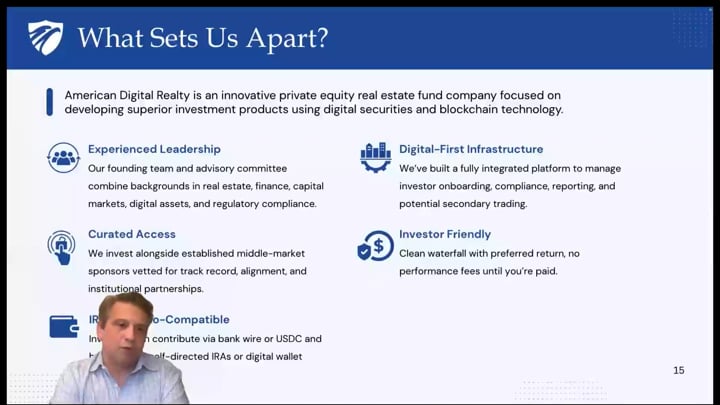
What sets us apart: small, focused team, alignment-first structure, and digital-first reporting/ownership.
The infrastructure stack:
tokenization platform provider (BlockTime Financial)
blockchain used for issuance/recordkeeping (Stellar)
Investor onboarding steps:
sign up, review offering docs, complete accreditation and KYC
fund via bank transfer or USDC (multi-chain support is mentioned)
access dashboard for allocation, distributions, and documents
Introduction to ADR and
US Diversified TREIF Webinar
Contact
American Digital Realty LLC,
100 Center Avenue Wilmington, DE 19807
Socials
Copyright © 2026 American Digital Realty
American Digital Realty and its affiliates (collectively, “American Digital Realty”) operate a website at AmericanDigitalRealty.com. No communication by American Digital Realty through this website or any other medium should be construed or intended as a recommendation to purchase, sell, or hold any securities, nor as investment, tax, financial, accounting, legal, regulatory, or compliance advice. Nothing on this website constitutes an offer to extend credit, an offer to purchase or sell securities, or a solicitation of any securities transaction. You are encouraged to consult with licensed legal professionals and investment advisors for any legal, tax, insurance, or investment-related guidance.
Offering pursuant to Reg D, Rule 506(c). Securities are offered only to accredited investors after verification. Not registered with the SEC. American Digital Realty LLC is an Exempt Reporting Adviser (ERA) under the Investment Advisers Act. It is not a fully registered investment adviser. ERA managers remain subject to SEC oversight and anti-fraud rules.
*Target returns are targets only. There can be no assurance the Fund will achieve these objectives; actual results may be materially different, including loss of capital. Past performance of real estate or other asset classes is not indicative of future results. Liquidity is not guaranteed; investors should be prepared to hold long term. Target returns are net of the Fund’s fees and underlying managers’ fees.
By using the American Digital Realty website, you accept our Terms of Service and Privacy Policy. While we strive to use reliable third-party data, we cannot guarantee the accuracy or completeness of information provided by investors or other external sources.
Legal